


for teams looking for a better path forward
More control over healthcare costs. Less work for your team.
Blackwell combines captive risk financing with proactive risk management for every member. We coordinate implementation and ongoing program management, giving you a recommendation you can explain and clear responsibility for the work.
Have a renewal coming up? We’ll tell you if Blackwell makes sense.
For 1/1 effective dates, send it by 11/15.
The renewal problem
Traditional funding models focus on who pays for risk, not what causes it.
Decisions happen too late
Most decisions happen during renewal, after the claims have already occurred.
The causes are hard to see
Fragmented data makes it difficult to identify which conditions, providers, or prescriptions are changing plan performance.
Responsibility is divided
The broker, underwriter, vendors, and employer may each see one piece of the problem. No one is coordinating the full program.
Have a renewal in play?
Send the current funding setup, the renewal pressure, and any claims data you have. We will tell you plainly whether Blackwell fits and what the most useful next step is.
How Blackwell delivers
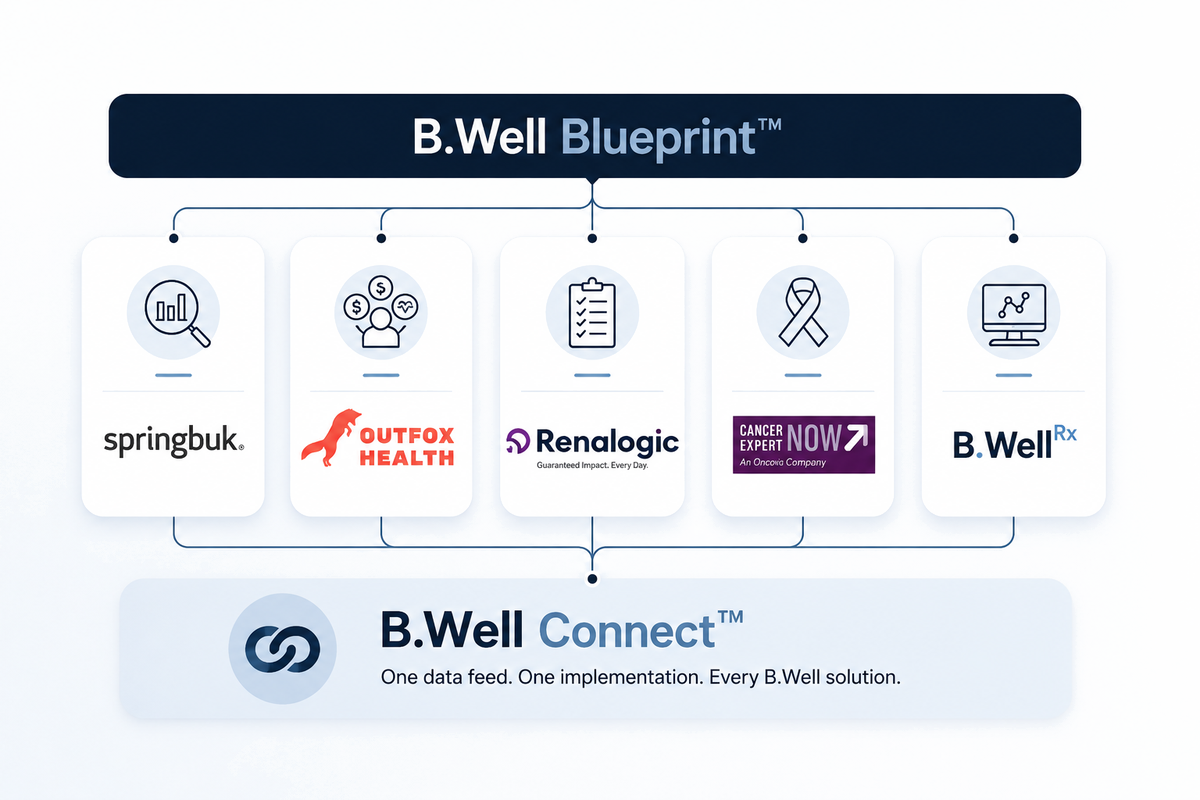
Three reasons to choose Blackwell.
Proactive risk management for every member
Every member must address all five B.Well Blueprint risk-management categories. Members can use the included solutions or qualifying vendors they already work with.
The same requirement across the risk pool
Every employer joining the captive must have proactive risk management in place. Members know the requirement applies across the pool.
Blackwell handles setup and ongoing coordination
Blackwell coordinates contracts, implementation, partner and TPA follow-up, and ongoing program management. B.Well Connect reduces separate data connections.
The five B.Well Blueprint components
Springbuk
Analytics that flag emerging high-cost conditions and utilization patterns.
Outfox Health
Care navigation that helps members find the right care and use their benefits.
Renalogic
Focused support for kidney cases with high-cost potential.
Cancer Expert Now
Second opinions and support for cancer cases with high-cost potential.
B.WellRx
Pharmacy consulting and PBM oversight, powered by Navion.
Included in Blackwell captive participation at no additional PEPM charge, subject to program terms.
The work Blackwell takes on
Managing each partner separately
A separate contract with each partner
A separate data connection to each solution
Separate follow-up with each partner and the TPA
An implementation plan you build and track yourself
With Blackwell
Consolidated contracting and one implementation plan
One data connection through B.Well Connect
One program-management contact
Ongoing partner and TPA follow-up handled by Blackwell
Which integrations apply is confirmed during implementation. Savings and clinical outcomes are not guaranteed.
Get the B.Well Blueprint Overview →How the financial model works
What is a group medical stop-loss captive?
Self-funded employers share a defined portion of high-cost claim risk while keeping stop-loss protection in place. Each employer pays for its own expected claims and participates in a shared risk layer with other employers in the captive.
More control
Employers have more say in plan design, partners, and how healthcare risk is managed.
Surplus opportunity
Employers may receive surplus when captive results are better than expected.
Greater predictability
A defined risk-sharing structure can reduce the impact of high-cost claim volatility.
Medical Stop-Loss Captive Guide
A practical overview of how the model works, what employers should expect, and how fit is evaluated.
Download the guide →Expected claims layer
Shared risk layer
Stop-loss protection
For cannabis employers
A health captive built for the cannabis industry
Humboldt Health is a cannabis-sector captive with embedded cost management and A-rated stop-loss, built for cannabis employers and the benefits brokers who serve them.
Explore Humboldt HealthHave a client to discuss?Every Blackwell member has proactive risk management in place
Every member must address all five B.Well Blueprint risk-management categories, using the included solutions or qualifying partners they already work with. B.Well Connect links the TPA to those solutions through one data connection.
One Data Connection to Every B.Well Solution.
B.Well Connect connects the TPA to the risk-management solutions through one data connection, so there are fewer separate connections to build and manage.
That means fewer disconnected launches, less manual coordination, and better information throughout the year.
Delivering better care through better partners.
Proven care strategies that drive real cost savings at the best price.












Who it is for
Built for groups that want to manage their healthcare plan like a business.
Blackwell is built for mid-sized employers, generally starting around 50 enrolled lives, and the brokers who advise them. Not every group is the right fit, and we would rather say so early.
A strong fit
Renewal increases, limited market options, or a recent shock claim.
Heavy pharmacy or chronic-condition spend.
Leadership that wants to see what drives cost and will act on it.
A multi-year view, with enough time to evaluate before the effective date.
Probably not a fit
Groups looking only for short-term premium relief.
Employers who want cost containment to be optional.
A set-it-and-forget-it approach to benefits.
Decisions made on the lowest admin fee alone.
Client results
How one conversation changed everything.
Case study · Medical device manufacturer, 228 employees
Completing the self-funding shift
A group that had circled self-funding for three years, cycling through PEO transitions and plan buy-downs without ever committing, finally moved forward once the conversation shifted from pricing comparison to risk structure.
Read the case study“Staying fully insured long-term is a losing strategy.”
From Blackwell
Your Stop-Loss Premium Should Do More Than Cover High-Cost Claims
For self-funded employers, stop-loss insurance serves an important purpose. It provides financial protection when medica...
What’s Driving Healthcare Renewals in 2027?
Your claims matter. So does the market you are renewing into. Segal’s 2026 medical stop-loss data shows an average premi...
Monthly Captive Reporting: Why Earlier Visibility Matters
Most captive reporting explains what already happened. Blackwell and Luzern Risk give brokers and employers a first-of-i...
Ready for a better healthcare strategy?
Share the current funding structure, renewal pressure, and available claims information. We will help assess fit and identify the most useful next step.